
HRA and Tax saving

You may not have your own house with a loan (as yet) but that doesn’t mean that you cannot avail of tax benefits. Even if you are staying on rent and your company is paying you house rent allowance (HRA) you can avail tax benefit. Many a times, your company’s HR department does the tax calculation for you, which is a great convenience, but it is always a good habit to know how the expenses can be deducted from your income so as to reduce your tax liability.
Of course this benefit (exemptions) can be availed only if you follow the existing tax structure.
Let me illustrate how much can be shown towards expenses. 
The least amount of the following three is considered eligible for the benefit:
1. Actual HRA received (per annum)
2. Actual rent paid (per annum) minus 10% of your salary (per annum)
3. If you are staying in a metro, then 50% of your salary or 40% of your salary
Now let us work out an example:
> You are staying in Mumbai and your salary is Rs 25,000/- per month
> The HRA received from your company is 12,000/- per month 
> Rent is Rs 10,000/- per month
Now, the calculation:
1. HRA received: 12,000 x 12 = 1,44,000/-
2. Rent – 10% salary: (10,000 x 12)-( (25,000 x 12)*10%) = 1,20,000 – 30,000 = 90,000
3. Staying in a metro: (25000 x 12) x 50%= 1,50,000/-
So the least of the above three is point # 2. Rs 90,000/-.
You are allowed to deduct this amount from your Income u/s 80 GG. This is how you can verify your tax statement.
For detailed calculations, do take support of your CA or financial consultant.
Thank you,
Anand Mhapralkar
Certified Financial Planner^CM
http://www.AnantWealth.com


Understand Your Home Loan

Almost everyone who dreams to own a home in Mumbai has to opt for a housing loan, given that the astronomical real estate rates in the city are more often than not generally way more than your savings! Buying a housing property in Mumbai does not come easy and cheap. Once you finalise on a neighbourhood and an appropriate size of an apartment well suited to you and your family, you have to look at the most important aspect of home buying—the cost.
I would say almost 90 per cent prospective buyers have to opt for a housing loan. Additionally, a housing loan also ensures the bank involvement in verifying  that the property is clear of any legal issues. 
There are a few things one should keep in mind before making such an important commitment:
1. Your total EMI (Equated Monthly Installment) should not exceed more than 40 per cent of your monthly income.
2. Compare the interest rate and check if it is floating or fixed. A floating rate is variable and mostly helpful, as the interest rates gradually go down.
3. Check if it is a repo-linked lending rate (RLLR). Many times, banks do not forward the interest-rate benefit to the borrowers. This new RLLR, on the other hand, will benefit borrowers as the bank will have to forward the interest-rate benefit as and when there are any changes.
4. Check if there are any pre-payment charges. No pre-payment charges makes the loan beneficial to you; try to make a lump-sum payment as and when you get any bonuses or extra profit from business, thus lowering on your interest expenses.
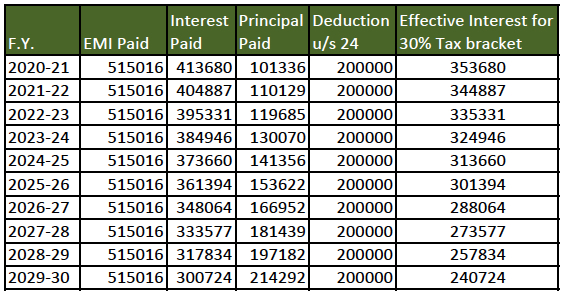
5. There is a tax benefit forwarded to home loans: you can deduct up to Rs 2,00,000/- u/s 24 towards interest payments and 1,50,000/- u/s 80c (this being the total amount which can be exempt under this section).
Let me illustrate the example in case of a Rs 50 lakh loan to be paid over 10 years.
Loan Amount: Rs 50,00,000/-
Loan Date: 1 April 2020
Tenure: 20 years
Interest rate: 8.35%
Your EMI will be: Rs 42,918/- (Approximate)

It is always better to make a informed decision.
Thank you 
Anand Mhapralkar
Certified Financial Planner^CM
+91 9820663784
http://www.AnantWealth.com

About Us

A secure future for you and your family that is based on a strong financial foundation is what every individual hopes to achieve but many rarely do. Anant Wealth Management has been established with the aim of transforming that hope into viable reality. The company has been founded by Anand Mhapralkar, a certified financial planner and member of an elite group of professionals certified by Financial Planning Standards Board (USA) licensed in India, which is recognised in 26 countries around the world.

Founded on the principle of ensuring financial freedom for all, our mission is to help you achieve your life goals, ensure you gain an insight into managing your finances, make your future secure and most importantly, financially independent. We will show you the shortest route to stability and security.

Your financial future. In your hands.

Founder

The third generation of a family-owned jewellery house, Anand Mhapralkar has spent several years running his own business, and gained deep insight into the operations and administrative management of a company—and more importantly, the value of winning the trust of his customers. As a joint secretary of the Maharashtra Saraf Suvarnakar Mahamandal, he further honed his understanding about the importance of providing financial security across the supply chain—from artisan to entrepreneur. Now as a certified financial planner, he brings his knowledge of managing the finances of a business to individual clients. 

Vision

Empowering, engaging and enlightening each and every client with the final aim of ensuring financial freedom for everyone.

Services

1. Comprehensive Financial Planning
2. Goal Based Planning
3. Wealth Management and Optimisation
4. Risk Management and Insurance

Retirement Planning
There are certain things that are inevitable, like beginnings and endings, growing up, getting an education, starting a job, building a family, and of course, retirement in our old age! One retires when you have enough savings or sources of income that don’t depend on you having to work. 
Only 7.4 percent of the working age population in India is covered under a pension programme, as of 2017, while it is 31 percent for Brazil, another emerging economy, and 65 percent for Germany, according to the World Economic Forum’s report on Global Human Capital. This is alarming! 
Being financially independent during retirement would be something every person would want to achieve. 
There are following questions you should ask yourself:

  1. When will I retire?
  2. Approximately what is my average lifespan?
  3. How much retirement corpus is required to sustain my living?
  4. Approximately how much should I invest or save till I reach my retirement age
    Call us to understand and plan!
    Because we believe in financial freedom for all!

Design a site like this with WordPress.com
Get started